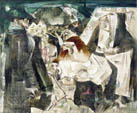
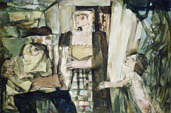
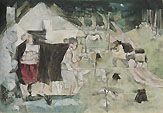
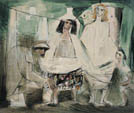
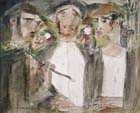
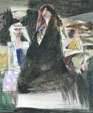
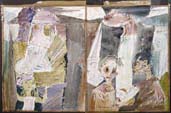
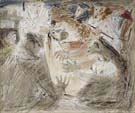
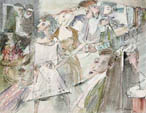
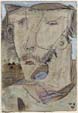
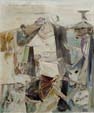
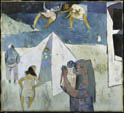
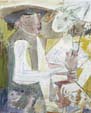
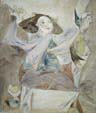
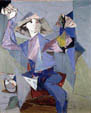
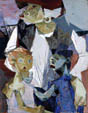
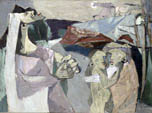
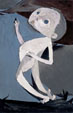
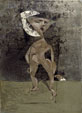
Encounters the 'Tinkers' near Tullamore, Co. Offaly (August 1945). The
vitality, mystery and wildness of these travelling people is admired by
le Brocquy: 'Most of all I was impressed by their insistence on freedom
- freedom from every external regulation - observing only their
own tribal rules, their tradition. Not, perhaps, altogether unlike
the independence of the artist within society.'60 Described as the once-dispossessed
people of confiscations
wandering without security of land, Earnán O'Malley remarks: 'They
are lithe and hardy, sharp in feature, and capable of sudden calls on endurance
from their uncertain way of life in a difficult climate. With them primitive
emotions are easily aroused and expressed; their woman drink and fight
as readily as their men, and bear children without halting the day's journey.
Their aloofness, intractability, and fierce independence interested le
Brocquy. They are, he could see, outside of the closely organised life
of the parish unit, looked on with mistrust and suspicion ... They become
a symbol of the individual as opposed to organised, settled society ...
For the creative worker they could represent the artist who deals in the
unexpected and the unrecognised and who suffuses with meaning familiar
things.'61 Armed with bicycle and sketchbook, the artist produces swiftly
executed life-sketches depicting their unruly way of life. The art critic
Dorothy Walker notes: 'He got on well with them because he was different
from them and did not attempt to identify with them, because they were
in fact extremely jealous of their own identity, of their own language shelta, a form of Irish, and of their own esoteric practices.'62
The artist explains: 'Faced with Cromwell's choice to Hell or Connaught,
the forebears of the travelling people took a third way. They took to the
road. In time they became the road - that which lies outside the
security of settled society - their wild nature as defiantly distinct as
that of a tiger.'63 According to Alistair Smith: 'Le Brocquy's interest
in the travelling way of being, like Synge's before him, is to be seen
in the context of the century's "discovery" of so-called "primitives",
or, rather, of societies where there still exist languages and customs
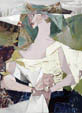
which have not been eroded by modern society.'64 Embarks on the 'Tinker
period' (c.1945-48), the largest distinguishable body of work to date. |