exhibition programme | paintings | tapestries | prints | chronology of a life | market | biography & bibliography | agents | news | contact


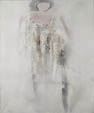
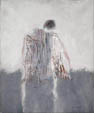
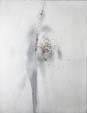
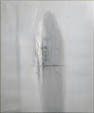
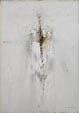
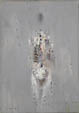
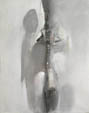
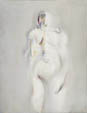
'White Period' Presences series (1956 - 1966)

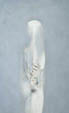
In the summer of 1955, the artist is commissioned to tour Spain by Ambassador magazine on behalf of the British textile trade. Accompanied by the photographer Jay, travels to Granada, Cordoba, Segovia, Madrid, Seville, noting numerous impressions for textile designs. The artist's discovery there of a 'persistent visual tension', is translated into numerous patterns drawn from a wide range of sources, including cobblestones, sickles, stucco in village walls, and Azulejos in El Greco's Toledo house. Contributes Pattern in Contrast: Hot, Dull-Cool, Bright, 'a colour impression by Louis le Brocquy' (Ambassador, No 10, London 1955). Three leading textile firms issue the designs: David Whitehead, Furnishing prints; Seckers', woven silks, and Horrockses, Fashion prints, one famously worn by Princess Margaret. Inspired by the violent contrast of sun seen through lattice blinds in Andalusia, designs Sol Y Sombra (1955), the seventh tapestry to date, conceived to hang vertically or horizontally as evidenced by date and signature. Identified as le Brocquy's only abstract work, the design coincides with a momentous change about to take place in his painting. The extensive tour of Spain in the summer of 1955, signals a turning point in the work. The summer of 1955 signals a turning point in the work: 'One day while passing through a village in La Mancha in shimmering heat, I stopped spellbound before a small group of women and children standing against a whitewashed wall. Here the intensity of the sunlight had interposed its own revelation, absorbing these human figures into its brilliance, giving substance only to shadow. From that moment I never perceived the human presence in quite the same way. I had witnessed light as a kind of matrix from which the human being emerges and into which it ambivalently recedes ­ with which it even identifies'. Le Brocquy's revelatory vision of whiteness is curiously echoed by an earlier experience while living at Albert Studios, recorded by Anne Madden: 'Snow had blanketed the city during the night. He woke to a white world with no relation to yesterday's actuality, silent, unmarked, as he walked out in the morning and crossed Albert Bridge Road into Battersea Park. As he moved through the stillness of the other world without footprint, the only sound the thump of snow from an overweighted bough, under the little bridge he was crossing a heron rose suddenly from the matrix of snow, hung in the air quite still for a moment, then flapped away in slow motion.' ... | CHRONOLOGY OF A LIFE PRESENCES
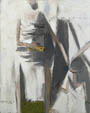

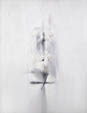
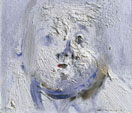
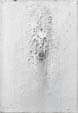
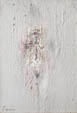
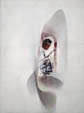
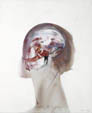
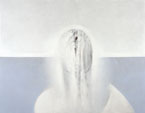
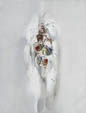
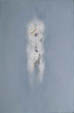
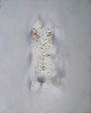
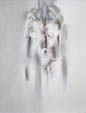
According to John Russell: 'There was from the very beginning a blanched look about many of his paintings: pure white light, pure white walls, pure white skin. Bone-white, chalk-white, almond-white were the adjectives that come to mind. Around the mid-1950's that whiteness, which had been simply a prevailing tonality, became the very element and substance of the paintings'. Embarks on the 'White Period' Presence paintings (c.1956-66) the fourth distinctive period in the artist's work. The generic term is first attributed during the exhibition 50 Ans d'Art Moderne, World Fair, Brussels, 1958, where it is remarked that in his latest work the human figure is no longer an abstraction drawn from living beings. Rather it has become a magic presence. The artist explains: 'An essential break occurred, where I began to concentrate on a single image emerging from a canvas, in which the composition, in the conventional sense of the word, had been destroyed or ignored. Quite a painful decision, in fact. I had always based myself on being a traditional painter in that I maintained that composition was important; all that had to be thrown out ... Then, later, I had the idea of conjuring up images out of nothing, out of light, out of the depths of the blank canvas, as it were.' According to Brian Kennedy: 'The theme which in its first phase was to occupy him for almost a decade, gradually became a vehicle of exploration for the whole of his later career'' Alistair Smith remarks: 'Le Brocquy's steps towards his position of analyst of the Irish imagination are fascinating to recount. It would be easy to underestimate in this story of brilliant and famous men the importance of a small painting of a child called Caroline. Painted in 1956, the year of le Brocquy's vita nuova, it measures no more than thirty centimeters across. First exhibited in 1957 with the original group of Presences, it was one of the paintings which seized the attention of Francis Bacon. Formed through only the minimum of descriptive brushwork, this is clearly a head which 'formed itself' ... The painting is Aristotelean in its premise that the eyes are the gateway to the soul, save that here the whole indistinct face provides that gateway'. John Montague further observes: 'Her eyes and nostrils are staring pinholes in a tossing sea of paint. Though very small, it is a portrait of real humanity and tenderness, which attempts to do justice to the spirit peering out of that shapeless face. It seems to me that here we have both the culmination of le Brocquy's earlier studies of children, immobile or isolated in rooms, and the unconscious ancestor of his later heads, with their awe before the human'.